
Book Cover Illustration vs Book Cover Design: What’s the Difference?
A reader may spend months with your story, but your cover gets only a few seconds to make the first impression.
A reader may spend months with your story, but your cover gets only a few seconds to make the first impression.
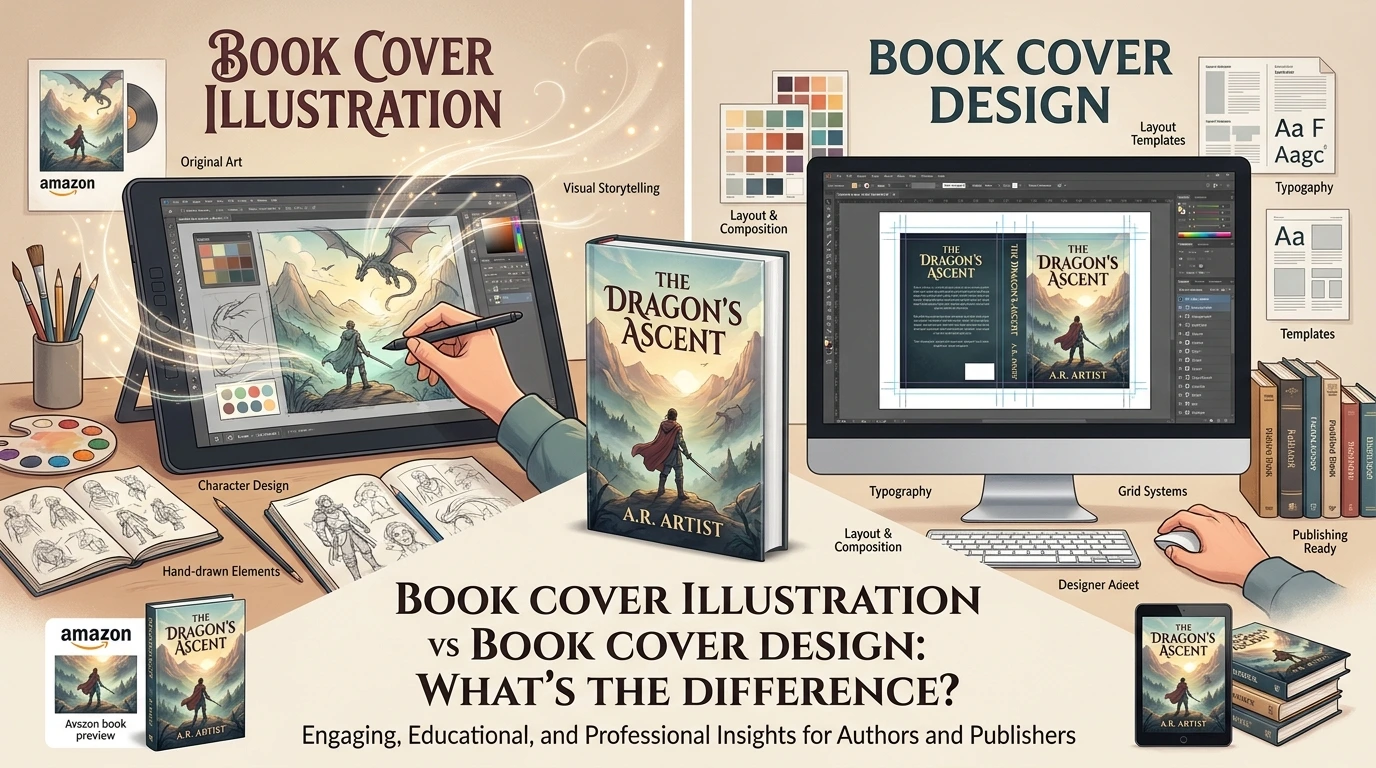
That is why authors often ask the same question early in publishing: Do I need book cover illustration, book cover design, or both? The two sound similar, but they are not the same thing. One creates the visual artwork. The other turns that artwork into a finished, market-ready cover.
Think of it this way: book cover illustration is the image that tells the emotional story. Book cover design is the full package that makes the cover readable, clickable, printable, and ready for publishing.
If you are planning a fiction book, nonfiction book, children’s book, novella, textbook, comic, or graphic novel, knowing the difference can save you money, prevent formatting problems, and help your book look more professional from the start.
At Illustration Pros, we create artwork and covers for authors, brands, and publishers. You can explore our Best illustration services to see how different visual styles can support publishing and book marketing goals.
What Is Book Cover Illustration?
Book cover illustration is the custom artwork created for the front of a book. It might be a painted fantasy scene, a romantic character moment, a children’s book character, a surreal symbolic image, a science-fiction city, or a bold comic-style hero.
The job of book cover illustration is to capture the tone of the story. It gives the reader a feeling before they read the title, description, or reviews.
A good cover illustrator thinks about emotion, genre, setting, lighting, shading, texture, visual composition, and storytelling. The artwork should hint at the book’s world without explaining everything.
For example, a romantic novella may use soft blush illustrations, warm lighting, and gentle body language. A science-fiction cover may use sharp perspective, metallic textures, glowing graphics, and dramatic atmosphere. A children’s book may use friendly characters, readable shapes, and expressive color.
That is the strength of book cover illustration: it creates the emotional hook.
What Is Book Cover Design?
Book cover design is the process of arranging all visual and text elements into a finished cover. It includes the cover art, title design, author name, subtitle, typography, front cover, spine, back cover, barcode area, trim size, bleed, and export settings.
A designer may use custom book cover illustration, stock graphics, photography, abstract illustrations, repeating patterns, doodles in titles, natural elements, or minimalist layouts. The final goal is not just to make the cover pretty. It must work as a marketing component.
A book cover has to function in many places: Amazon thumbnails, online eBooks, paperback books, physical covers, bookstore browsing, banner advertisement placements, audiobook listings, social media posts, and sometimes even billboard advertising.
That means book cover design is about clarity. Can readers see the title at thumbnail size? Does the genre feel obvious? Is the font size readable? Is the text placement balanced? Does the spine work for paperback or hardcover books?
A professional book cover designer brings the artwork, typography, layout, and publishing requirements together so the book is ready for readers and platforms.
Book Cover Illustration vs Book Cover Design: The Simple Difference
The easiest way to understand it is this:
Book cover illustration = the artwork.
Book cover design = the finished cover layout.
A cover illustrator creates the image. A book cover designer decides how the image, title, author name, subtitle, spine, back cover, and publishing specs work together.
Book Cover Illustration vs Book Cover Design
Feature | Book Cover Illustration | Book Cover Design |
Main purpose | Creates the original cover artwork | Turns artwork into a finished, publishing-ready cover |
Focus | Visual storytelling, mood, characters, scene, emotion | Layout, typography, title placement, spine, back cover, file setup |
Best for | Fantasy, children’s books, comics, graphic novels, romance, sci-fi | eBooks, paperbacks, hardcovers, audiobooks, publisher submission |
Created by | Cover illustrator | Book cover designer |
Includes | Custom art, characters, background, objects, and visual style | Title, author name, subtitle, typography, front cover, spine, back cover |
Does it handle formatting? | Usually no | Yes |
Does it include typography? | Usually no, unless agreed | Yes |
Output | Artwork file, such as PNG, JPG, PSD, or a layered file | Final cover files for Kindle, paperback, hardcover, audiobook, or print |
Main value | Makes the book visually original and emotionally engaging | Makes the book professional, readable, and ready to publish |
You need it when | You want custom cover art | You need a complete cover layout and publishing file |
You may need a book cover illustration if you already have a designer, publisher, or formatting team. You may only need a book cover design if you have already finished artwork, photography, or licensed graphics.
But many authors need both, especially if they are self-publishing through Kindle Direct Publishing, preparing paperback cover dimensions, or creating digital versions for multiple platforms.
The best book cover illustrations are powerful, but they still need a strong design to sell well. Beautiful artwork can fail if the title is too small, the genre is unclear, or the composition does not work as an Amazon thumbnail.
Why Book Covers Matter for Sales and Reader Attention
A book cover is not just decoration. It is one of the first book marketing tools a reader sees.
Before someone reads your description, opens the preview, checks your reviews, or looks at your author bio, they usually see the cover. That first impression can influence clicks, views, eyeballs, and reader attention.
For online eBooks, your cover often appears as a small thumbnail. That means the title, central image, contrast, and genre signals need to be clear even at a tiny size. For paperback books, the physical cover also needs to feel good in bookstore browsing, author events, and mailed copies.
A perfect book cover does not mean the most detailed cover. It means the right cover for the reader, genre, and publishing format.
A literary masterpiece still needs a cover that tells readers where it belongs. A thriller should not look like a soft romance. A business book should not look like a children’s book. A fantasy novel should not look like a textbook unless that contrast is intentional.
When You Need Book Cover Illustration
You need book cover illustration when your book depends on a visual idea that cannot be captured well with simple typography, stock photography, or basic graphics.
This is especially true for fiction books, children’s books, fantasy stories, comic books, graphic novels, science-fiction covers, and character-driven stories.
A custom cover illustrator can create a world that does not exist yet. That matters if your story has original characters, imaginary locations, magical objects, unusual creatures, or a specific emotional scene.
You may also need book cover illustration when you want bestseller quality and a more ownable visual identity. Free illustrations and generic graphics can be useful for drafts, but they often appear on multiple projects. Custom artwork gives your book a more distinctive first impression.
For authors who want something original, custom illustration design can help turn story details into cover art that matches the genre, audience, and mood.
When You Need Book Cover Design
You need book cover design when your artwork or visual idea must become a real publishing file.
A designer handles the practical parts: canvas size, book cover dimensions, file type, typography, front cover layout, spine setup, back cover formatting, and publisher submission requirements.
This matters because publishing platforms can reject files that do not meet their specifications. For example, Amazon KDP recommends Kindle eBook cover images at 2,560 pixels high by 1,600 pixels wide, with JPEG preferred and a 300 DPI/PPI minimum for that guideline page.
Paperback covers are different because they include the front cover, spine, and back cover in one full-wrap file. Amazon’s KDP cover calculator exists because exact dimensions depend on trim size, page count, paper type, and binding choices.
So, even if you already have excellent book cover illustration, you still need design work to make sure everything fits the actual book type.
When You Need Both Illustration and Design
Most self-published authors need both.
Here is a simple example. Imagine you wrote a fantasy novella. You want a glowing forest, a mysterious character, and a magical object on the front cover. That is the book cover illustration part.
But you also need the title, author name, subtitle, genre-appropriate fonts, a readable Amazon thumbnail, a paperback spine, a back cover blurb, barcode placement, and correct KDP cover size. That is book cover design.
If you only hire a cover illustrator, you may receive a beautiful image but not a finished cover. If you only hire a designer without original artwork, you may get a clean layout but not the emotional storytelling your book needs.
For genres like fantasy, children’s books, romance, science fiction, comics, and graphic novels, both services often work best together.
Book Cover Illustration for Different Genres
Different genres need different visual signals. This is where book cover illustration becomes more strategic than simply “drawing something nice.”
Fiction books
Fiction books often need emotion, symbolism, and atmosphere. The cover art may show a character, scene, object, or abstract mood. The goal is to make readers curious.
A literary fiction cover might use minimalism, surrealism, or natural elements. A mystery cover may use shadow, limited color, and tension. A romantic novella may use warmth, softness, and intimate composition.
Children’s books
Children’s books usually need expressive characters, clear shapes, friendly color, and readable storytelling. The artwork must appeal to both children and parents.
For children’s books, book cover illustration should match the inside pages. If the cover looks detailed and painterly but the interior art looks simple, the book may feel inconsistent.
Comic books and graphic novels
Comic book covers need energy. They often use strong poses, action, dramatic lighting, bold line work, and clear character focus.
For this type of project, a comic book cover design should consider title placement, series branding, issue number, character hierarchy, and cover composition.
Nonfiction books
Nonfiction books may not always need full book cover illustration, but it can help when the topic needs visual symbolism.
A business book might use abstract illustrations. A wellness book might use mother earth illustrations or natural elements. A memoir may use a meaningful object or location. A textbook may need clear graphics and structured visual communication.
Book Cover Design for Digital, Paperback, Hardcover, and Audiobook Formats
Book cover design changes depending on the format.
Online eBooks
For Kindle and other online eBooks, the cover must work as a vertical digital image. The biggest challenge is thumbnail readability. Your title design and main image should still make sense when the cover appears small.
Amazon’s KDP guidance says an ideal eBook cover image ratio is at least 1.6:1, meaning 1,600 pixels tall for every 1,000 pixels wide.
This is why some detailed cover illustrations fail online. If the scene has too many tiny details, the cover may look muddy as a thumbnail.
Paperback books
Paperback books need a full cover wrap: front cover, spine, and back cover. The spine width depends on book length, paper type, and trim size.
KDP says paperback covers with bleed should add 0.125 inches / 3.2 mm to the top, bottom, and outside edges.
This is one reason book formatting matters. Your illustration may need extra background space around the edges so important details are not cut off during printing.
Hardcover books
Hardcover books usually require more setup than eBooks. Depending on the publisher, the designer may need to account for wrap areas, jacket flaps, case laminate, spine text, and physical production requirements.
A cover made only for Kindle will not automatically work for hardcover books.
Audiobook covers
Audiobook cover size is different again. ACX requires square cover art with a 1:1 ratio, at least 2400 x 2400 pixels, and accepts JPG, PNG, or TIF formats.
This means a vertical paperback or Kindle cover cannot simply be squeezed into a square. The composition needs to be adjusted so the title, author name, and main artwork still feel balanced.
Book Cover Dimensions: What Authors Should Know
Book cover dimensions are not one-size-fits-all.
A Kindle eBook, audiobook, mass market paperback, trade paperback, and hardcover book may each need different files. Even two paperback books can require different cover dimensions if the trim size or page count changes.
Common paperback trim sizes include formats like 5" x 8", 5.5" x 8.5", and 6" x 9", but the final full-wrap cover size depends on the spine. That spine depends on book length and paper choice.
This is why authors should decide the book type early. A designer cannot accurately finalize a paperback cover without knowing trim size, page count, paper color, and publishing platform.
For Kindle Direct Publishing, the safest workflow is to use Amazon’s official cover calculator or template after your book formatting is complete.
If you are hiring someone for book cover illustration, tell them where the book will be published. A cover for Amazon, IngramSpark, ACX, or a private printer may need different setup.
Book Cover Trends: What Still Works and What to Use Carefully
Trends can be helpful, but they should not control your cover. A cover that only follows trends may look dated quickly.
Some 2021 book cover trends included repeating illustrations, repeating patterns, abstract illustrations, minimalism, doodles in titles, surrealism, and natural elements. Many of these still appear in modern book covers, but the best choice depends on genre.
Minimalist book cover styles can suggest sophistication and modernism, especially for nonfiction, literary fiction, and poetry. But minimalism may not work if your fantasy readers expect rich worldbuilding.
Doodles in titles can feel playful and personal, especially for memoirs, humor, young adult stories, or creative nonfiction. But they may feel too casual for serious academic books.
Surrealism can work beautifully for literary fiction, psychological stories, and speculative fiction. Mother earth illustrations and natural elements can work for wellness, sustainability, poetry, and environmental topics.
The smartest approach is to study book cover trends inside your genre, not across all publishing. A romance reader, science-fiction reader, and business reader respond to different visual cues.
The Role of Typography in Book Cover Design
Typography can make or break a cover.
You can have a beautiful book cover illustration, but if the title design is weak, the cover may still look amateur. Font choice, font size, spacing, contrast, and text placement all affect readability.
For Amazon thumbnails, large, readable title text matters. For physical covers, the spine must also be legible. For nonfiction books, the subtitle may need more space. For fiction books, the author's name may become a major selling point if the writer already has an audience.
A strong designer does not simply place text over artwork. They plan cover composition so the illustration leaves natural space for the title, author name, and other text.
This is why the cover illustrator and designer should ideally think about the layout together. The artwork should not put the main character exactly where the title needs to go.
Common Mistakes Authors Make
One common mistake is commissioning book cover illustration before deciding the book format. If the artist creates a tight vertical image, it may not have enough room for a paperback wrap, audiobook square crop, or banner advertisement.
Another mistake is using too many visual ideas. A cover does not need to show every character, scene, symbol, and plot twist. It needs one strong promise.
Some authors also choose fonts too late. The title should be part of the design from the beginning, not added as an afterthought.
Another issue is relying too heavily on free illustrations or customizable illustrations without checking whether the style appears on many other book covers. Free assets can be useful for early mockups, but they may not create a distinctive brand for your book.
A final mistake is ignoring genre. Your cover should feel fresh, but readers still need to recognize what kind of book it is.
How the Book Cover Process Usually Works
A clean process helps avoid confusion.
First, the author shares the manuscript summary, genre, audience, book type, publishing platform, and examples of covers they like. This gives the cover illustrator and designer a clear direction.
Next, the creative team develops the artistic direction. This may include mood references, cover composition, color direction, typography ideas, and rough sketches.
Then the book cover illustration is created. The artist focuses on character, scene, emotion, lighting, shading, texture, and storytelling.
After that, the design stage begins. The designer adds title design, author name, subtitle, text placement, front cover layout, spine, back cover, and final formatting.
Finally, the files are exported for the correct use: Kindle, paperback, hardcover, audiobook, publisher submission, or promotional graphics.
How to Brief a Cover Illustrator or Designer
A good brief saves time and improves the final result.
Include your title, author name, genre, target readers, book length, format, trim size, publishing platform, and deadline. Add a short summary of the story, but do not send only the full manuscript and expect the artist to guess what matters most.
For book cover illustration, describe the emotion of the story. Is it mysterious, warm, dark, funny, romantic, magical, bold, or quiet? The emotion helps shape lighting, color, character pose, and composition.
Also mention anything that must not appear. Sometimes that is just as useful as what you want.
Share 3–5 book covers from your genre that you like, but explain why. Do you like the typography, color, mood, character style, or layout? This helps avoid copying while still giving direction.
Should You Use Free Illustrations, Stock Art, or Custom Cover Art?
Free illustrations, stock graphics, and customizable illustrations can work for simple projects, early drafts, internal documents, or low-budget experiments.
But for commercial publishing, custom book cover illustration usually gives you stronger originality and better control. You can match the character, scene, genre, and tone of the story instead of forcing your book to fit available graphics.
Stock-style covers can also create a problem when multiple authors use similar images. Readers may not notice every duplicate, but a familiar-looking cover can weaken your book’s identity.
Custom cover art is especially valuable for fiction books, children’s books, fantasy, science fiction, comics, graphic novels, and any project where the image carries the emotional story.
What Makes the Best Book Cover Illustrations?
The best book cover illustrations do three things well.
First, they communicate genre quickly. A reader should understand whether the book is fantasy, romance, mystery, children’s fiction, science fiction, or nonfiction without needing a long explanation.
Second, they create emotion. Cover art should suggest the tone of the story. A tense thriller, soft romantic novella, adventurous children’s book, and surreal literary novel should not feel the same.
Third, they leave room for design. A great illustration still needs title placement, author name, and readable cover composition. The image should support the whole cover, not fight against it.
Bestseller quality is not about copying a New York Times bestseller. It is about understanding why successful covers work: clear genre signals, strong visual hierarchy, emotional pull, and professional finishing.
Final Takeaway: Which One Do You Need?
If you need original artwork, you need a book cover illustration.
If you need a finished publishing file with title, layout, spine, back cover, and correct dimensions, you need a book cover design.
If you are self-publishing a serious book, you probably need both.
A cover illustrator gives your book its visual story. A book cover designer turns that visual story into a market-ready cover for readers, platforms, and print production. When both work together, your book has a much better chance of looking professional online, in print, and across marketing materials.
For authors who want support from concept to final cover, Illustration Pros offers artwork, layout, and publishing-ready cover support. Start with our Best illustration services, explore our professional book cover designer service, or request custom illustration design for your next book project.


