
Types of Illustrations: 15 Popular Styles Explained
Illustration is one of the oldest and most flexible forms of visual communication. Before people could scroll through websites, open graphic novels, or watch animated ads, they were already using drawings to explain ideas, tell stories, and make information easier to remember.
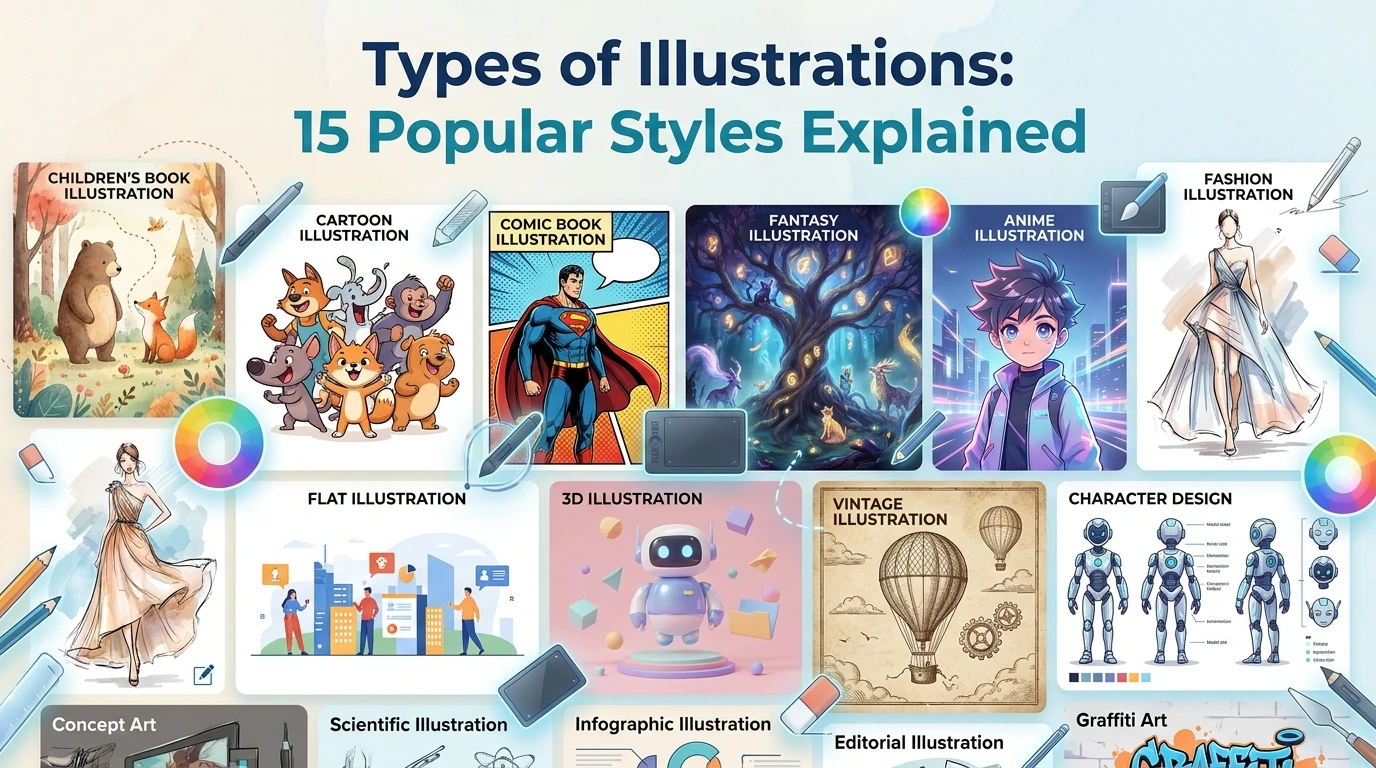
Illustration is one of the oldest and most flexible forms of visual communication. Before people could scroll through websites, open graphic novels, or watch animated ads, they were already using drawings to explain ideas, tell stories, and make information easier to remember.
That is why understanding the types of illustrations matters. Whether you are creating a children’s book, designing a brand mascot, planning a comic book cover, or building artwork for a product campaign, the illustration style you choose affects how people feel about your message.
Some styles feel playful. Some feel premium. Some make complex ideas easier to understand. Others create mood, fantasy, humor, or emotional depth. In this guide, we will walk through 15 popular types of illustrations, where they are used, and how to choose the right style for your project.
If you are looking for professional artwork for a book, brand, campaign, or character, you can also explore our illustration services to see how different styles can be used in real projects.
What Are Illustrations?
Illustrations are visual representations created to explain, decorate, support, or tell a story. They can be made through traditional illustration methods such as pencil, ink, watercolor, gouache, and acrylic, or through digital illustration using tools like Adobe Photoshop, Procreate, Illustrator, and other digital art software.
At their core, illustrations help people understand something faster. A paragraph can explain a character, but one strong image can show their personality, mood, clothing, world, and story arc in seconds.
That is why illustrations are used in publishing, advertising, product design, game art, animation, fashion, education, and branding. They are not just decoration. They are a practical art form built around visual storytelling.
When people search for types of illustrations, they are often trying to answer one simple question: “What style fits my idea best?” The answer depends on audience, purpose, budget, platform, and emotional tone.
Digital Illustration vs Traditional Illustration
Before we look at the main types of illustrations, it helps to understand the two broad creation methods: digital and traditional.
Digital illustration
Digital illustration is created using tablets, styluses, and digital art software. Artists often use Adobe Photoshop, Procreate, Clip Studio Paint, or Illustrator to sketch, color, shade, and finish the artwork.
This style is popular because it allows flexible revisions, clean file exports, layered editing, and easy formatting for websites, books, ads, animation, and social media. Digital illustration services are especially useful when a client needs artwork in multiple sizes or formats.
For example, a character design can be created once, then adjusted for a book cover, website banner, social media post, sticker, and animation concept. That flexibility is one reason many businesses now prefer digital illustration for commercial projects.
Traditional illustration
Traditional illustration is created with physical materials such as pencil, ink, watercolor, markers, oil paint, charcoal, or pastels. It often has a handmade texture that feels warm, imperfect, and expressive.
You will see traditional illustration in children’s books, fine art prints, editorial pieces, book illustration, fashion sketches, and vintage-inspired artwork. Techniques like hatching, crosshatching, line weight control, shading, and textured brushwork are especially important here.
Many modern artists combine both methods. They might sketch by hand, scan the drawing, then color it digitally. This mix can produce artwork that feels handcrafted while still being practical for publishing and commercial use.
15 Popular Types of Illustrations
There are many types of illustrations, but these 15 are among the most common in books, branding, games, advertising, fashion, and digital media.
1. Children’s Book Illustration
Children’s book illustration is designed to support storytelling for young readers. It often uses expressive characters, warm colors, clear emotions, and easy-to-follow scenes.
This style depends heavily on visual storytelling. Children may not understand every word yet, but they can follow mood, action, and character relationships through the pictures. Good children’s book illustration uses composition, perspective, gesture drawing, facial expression, and visual symbolism to carry the narrative.
For example, a lonely child character might be drawn small inside a large room. A confident character might stand tall with open body language. These choices help children feel the story, not just read it.
This is one of the most commercially important types of illustrations because authors, publishers, educators, and self-publishing creators often need full-page illustrations, spot illustrations, book covers, character sheets, and print-ready layouts.
Best for: Picture books, early readers, educational books, bedtime stories, activity books
Common tools: Procreate, Photoshop, watercolor, ink, colored pencils
Key skills: Character design, composition, emotion, story pacing, publishing formats
2. Book Cover Illustration
Book cover illustration is made to sell the story before someone reads the first page. It has to communicate genre, mood, audience, and quality almost instantly.
A fantasy book cover may use dramatic lighting, strong perspective, magical symbols, and detailed realism. A children’s book cover may use bright colors and friendly character design. A romance or mystery cover may rely on atmosphere, fabric draping, body language, and careful use of visual symbolism.
This is different from a simple book cover design. Illustration creates the artwork, while cover design usually includes typography, layout, spine, back cover, barcode space, and publishing setup.
If you need a polished cover for publishing, working with a professional book cover designer can help make sure the artwork and layout work together.
Best for: Novels, children’s books, fantasy books, memoirs, graphic novels
Common tools: Photoshop, Procreate, Illustrator, mixed media
Key skills: Composition, typography awareness, genre research, visual hierarchy
3. Comic Book Illustration
Comic book illustration tells a story through panels, speech bubbles, action, pacing, and character movement. Unlike a single image, comic art must guide the reader from one moment to the next.
This style depends on anatomy, human form, gesture drawing, facial expression, dramatic angles, and line weight. Artists also use hatching and crosshatching to create shadow, energy, and texture.
Comic book illustration is often confused with cartoon illustration, but they are not the same. Cartoon illustration can be a single playful image. Comic book illustration usually involves sequential storytelling, panels, dialogue, and a clear narrative.
For covers, the artwork needs to be even more dramatic. A strong comic book cover design must grab attention while hinting at the story inside.
Best for: Comics, graphic novels, manga-inspired stories, superhero art, webcomics
Common tools: Clip Studio Paint, Photoshop, ink, markers
Key skills: Panels, anatomy, pacing, action poses, speech bubble planning
4. Character Design Illustration
Character design is the process of creating a person, creature, mascot, hero, villain, or fantasy figure with a clear personality. It is used in books, animation, games, comics, advertising, and branding.
A good character is not just “nice-looking.” Their shape, clothing, posture, color palette, facial features, and props should tell you who they are. A nervous character may have rounded shoulders and smaller gestures. A bold character may use sharp shapes, strong contrast, and confident poses.
Character design often includes front, side, and back views, expression sheets, pose studies, and costume details. Artists need strong drawing fundamentals, stylized anatomy, gesture drawing, and knowledge of the human form.
Among the many types of illustrations, character design is one of the most useful because the same character can appear across books, games, merchandise, ads, and animation.
Best for: Books, games, animation, mascots, comics, brand storytelling
Common tools: Procreate, Photoshop, Clip Studio Paint
Key skills: Anatomy, personality, silhouette, costume design, expressions
5. Cartoon Illustration
Cartoon illustration is playful, simplified, and expressive. It often exaggerates features, emotions, and movement to make the artwork easy to understand.
This style is used in children’s books, ads, stickers, social media content, educational material, and brand mascots. It can be silly, clever, cute, bold, or satirical, depending on the audience.
Cartoon illustration does not always mean childish. Many brands use cartoon artwork because it makes them feel friendly and approachable. A financial app, for example, might use cartoon characters to make saving money feel less stressful.
The key difference between a cartoon and a comic is structure. Cartoon illustration can stand alone. Comic book illustration usually works in panels with a continuing narrative.
Best for: Kids’ content, mascots, social media, explainer graphics, ads
Common tools: Illustrator, Procreate, Photoshop, markers
Key skills: Simplification, expression, line weight, humor, shape language
6. Caricature Illustration
Caricature is an illustration style that exaggerates a person’s features while keeping them recognizable. It might enlarge the nose, stretch the chin, emphasize the hairstyle, or amplify facial expressions.
This style is often used for entertainment, editorial cartoons, event art, political commentary, and personalized gifts. It can be funny, sharp, affectionate, or critical depending on the context.
Caricature requires more skill than people assume. The artist must understand anatomy, facial structure, proportion, and likeness before exaggerating anything. Without that foundation, the image can look random instead of intentional.
As one of the more personality-driven types of illustrations, caricature works best when the goal is humor, recognition, or social commentary.
Best for: Editorial art, events, gifts, satire, social media portraits
Common tools: Pencil, ink, Photoshop, Procreate
Key skills: Likeness, exaggeration, anatomy, facial expression
7. Fantasy Illustration
Fantasy illustration creates imaginary worlds, magical characters, mythical creatures, and dramatic scenes. It is common in books, games, concept art, posters, card games, and entertainment design.
This style often uses realism mixed with imagination. Artists may paint dragons, castles, enchanted forests, warriors, spirits, or dreamlike landscapes. Lighting, shading, texture, and perspective play a major role in making fantasy scenes feel believable.
A fantasy illustration is successful when the viewer feels like the world existed before the image and will continue after it. Small details such as worn armor, ancient symbols, weathered stone, or glowing objects can make the scene feel alive.
This is one of the most visually rich types of illustrations, but it also requires strong technical skill and planning.
Best for: Fantasy novels, game art, posters, card decks, concept art
Common tools: Photoshop, Procreate, Blender, traditional painting
Key skills: Realism, lighting, worldbuilding, texture, composition
8. Anime Illustration
Anime illustration is inspired by Japanese animation and manga. It often features expressive eyes, stylized anatomy, clean line art, dramatic emotions, and distinctive character designs.
This style is popular in fan art, web novels, games, comics, merchandise, animation concepts, and online communities. It can range from cute and soft to dark, cinematic, and highly detailed.
Anime illustration uses strong visual storytelling. Hair shape, eye design, costume details, color palette, and pose all help define the character’s personality. Even subtle choices in line weight and shading can change the emotional tone.
For beginners, online art courses often teach anime through drawing fundamentals, gesture drawing, stylized anatomy, and facial expression practice.
Best for: Manga-inspired books, games, webcomics, character art, merchandise
Common tools: Clip Studio Paint, Procreate, Photoshop
Key skills: Stylized anatomy, clean lines, expressions, costume design
9. Fashion Illustration
Fashion illustration focuses on clothing, fabric draping, pose, movement, and style. It is used by designers, fashion brands, magazines, educators, and product teams.
Unlike technical garment drawings, fashion illustration often exaggerates the human form to make clothing look elegant and expressive. Long figures, flowing lines, confident poses, and graceful movement are common.
This style requires knowledge of anatomy, fabric behavior, folds, texture, and silhouette. A silk dress should not fall like denim. A structured jacket should not move like chiffon. These details separate strong fashion illustration from basic figure drawing.
Fashion illustration has real industry relevance in design, advertising illustration, editorial content, runway concepts, and product design.
Best for: Fashion brands, lookbooks, editorial art, design concepts, product sketches
Common tools: Markers, watercolor, ink, Procreate, Photoshop
Key skills: Fabric draping, gesture, anatomy, texture, style
10. Editorial Illustration
Editorial illustration supports articles, magazines, blogs, newspapers, and opinion pieces. Its job is to communicate an idea quickly, often with symbolism or metaphor.
For example, an article about burnout might show a person carrying a glowing phone like a heavy stone. A story about climate change might show a melting city inside an hourglass. These images do not just decorate the article; they add meaning.
Editorial work often uses visual symbolism, clever composition, limited color palettes, and strong conceptual thinking. It can be flat, realistic, textured, cartoon-like, or abstract.
This is one of the most idea-driven types of illustrations because the message matters as much as the drawing style.
Best for: Blogs, magazines, newspapers, thought leadership, reports
Common tools: Photoshop, Illustrator, Procreate, collage, ink
Key skills: Concept development, symbolism, clarity, composition
11. Advertising Illustration
Advertising illustration is created to promote a product, service, campaign, or brand message. It must be attractive, memorable, and easy to understand.
You will see it in posters, packaging, social media ads, product launches, website banners, email campaigns, and billboards. Sometimes it explains a product. Sometimes it creates a mood. Sometimes it makes a brand feel more human.
Advertising illustration can use flat illustration, 3D illustration, cartoon illustration, realism, or vintage illustration depending on the campaign. The best style depends on the audience and the action you want them to take.
Businesses often choose to outsource illustration services when they need commercial artwork but do not have an in-house art team. This gives them access to professional illustration services without hiring full-time artists.
Best for: Campaigns, product launches, posters, websites, social ads
Common tools: Illustrator, Photoshop, Procreate, 3D software
Key skills: Visual communication, branding, composition, commercial clarity
12. Flat Illustration
Flat illustration uses simple shapes, clean colors, minimal shading, and clear composition. It is common in websites, apps, explainer graphics, startup branding, and digital products.
This style became popular because it is easy to read on screens. It loads well visually, works across different sizes, and can make complex topics feel simple.
Flat illustration is often used in onboarding screens, landing pages, icons, product explainers, dashboards, and educational graphics. It may look simple, but good flat illustration still requires strong composition, color balance, visual hierarchy, and clear symbolism.
If your business needs clean, modern artwork for a website or campaign, custom illustration design can help create visuals that match your brand instead of relying on generic stock graphics.
Best for: Websites, apps, SaaS graphics, explainer content, icons
Common tools: Illustrator, Figma, Photoshop, Procreate
Key skills: Simplicity, shape language, color, layout, clarity
13. 3D Illustration
3D illustration uses digital modeling, lighting, materials, and rendering to create artwork with depth and volume. It can look realistic, playful, futuristic, or highly stylized.
This style is used in product design, advertising, websites, game art, app graphics, icons, and character work. A 3D mascot, for example, can feel more tangible than a flat drawing. A 3D product illustration can show shape, texture, and lighting in a polished way.
3D illustration depends on composition, perspective, lighting, shading, texture, and material knowledge. Artists may use software like Blender, Cinema 4D, ZBrush, or other 3D tools.
Among the different types of illustrations, 3D is especially useful for brands that want a modern, premium, or tech-forward look.
Best for: Product visuals, app graphics, mascots, ads, game assets
Common tools: Blender, Cinema 4D, Photoshop
Key skills: Modeling, lighting, rendering, texture, perspective
14. Vintage and Retro Illustration
Vintage illustration and retro illustration use visual styles inspired by older design periods. This can include 1950s advertising art, old comic colors, hand-painted posters, classic packaging, or textured print effects.
These styles are popular because they create nostalgia. They can make a brand feel established, playful, artistic, or emotionally familiar.
Vintage illustration often uses muted colors, grain, worn textures, strong line work, and traditional composition. Retro illustration may use bold colors, simplified shapes, halftone effects, and stylized characters.
This style works well for food brands, music posters, book covers, apparel, packaging, and themed campaigns.
Best for: Packaging, posters, apparel, branding, book covers, music art
Common tools: Photoshop, Illustrator, Procreate, ink, screen-print effects
Key skills: Texture, period research, color palettes, typography awareness
15. Concept Art Illustration
Concept art is used to explore ideas before final production. It helps teams visualize characters, environments, props, costumes, creatures, vehicles, and worlds.
This style is common in games, animation, films, advertising, and product design. A concept artist may create many versions of the same idea before the final direction is chosen.
Concept art is not always polished. Sometimes the goal is speed and exploration. The artist focuses on mood, shape, lighting, perspective, and function. For example, a game studio may need 20 creature sketches before choosing one for full development.
This is one of the most practical types of illustrations for creative industries because it helps teams make decisions before investing in full production.
Best for: Games, animation, films, product design, worldbuilding
Common tools: Photoshop, Procreate, Blender, 3D blockouts
Key skills: Ideation, speed, perspective, lighting, design thinking
Quick Comparison of Illustration Styles
Illustration Style | Best Used For | Common Look | Main Skill Needed |
Children’s book illustration | Picture books, education | Warm, expressive, story-led | Emotion and storytelling |
Book cover illustration | Publishing | Genre-focused, polished | Composition |
Comic book illustration | Comics, graphic novels | Sequential, dramatic | Panels and pacing |
Character design | Games, books, mascots | Personality-driven | Anatomy and silhouette |
Cartoon illustration | Ads, kids’ content, brands | Playful, simplified | Expression |
Caricature | Events, satire, gifts | Exaggerated likeness | Facial structure |
Fantasy illustration | Books, games, posters | Magical, detailed | Lighting and worldbuilding |
Anime illustration | Manga, games, fan art | Stylized, expressive | Stylized anatomy |
Fashion illustration | Apparel, editorials | Elegant, pose-focused | Fabric draping |
Editorial illustration | Articles, blogs | Conceptual, symbolic | Visual metaphor |
Advertising illustration | Campaigns, products | Clear, persuasive | Commercial communication |
Flat illustration | Websites, apps | Simple, modern | Clarity |
3D illustration | Products, tech, mascots | Dimensional, polished | Rendering |
Vintage illustration | Packaging, posters | Nostalgic, textured | Style research |
Concept art | Games, animation, films | Exploratory, imaginative | Visual development |
How to Choose the Right Type of Illustration
Choosing between different types of illustrations becomes easier when you start with the project goal.
If you are creating a children’s book, you need emotional clarity, consistent characters, and strong page-to-page storytelling. If you are creating a brand mascot, you need memorable character design and commercial usability. If you are creating a fantasy cover, you need atmosphere, lighting, and genre appeal.
Think about where the artwork will appear. A website illustration needs to be clear at small sizes. A book cover needs to stand out as a thumbnail. A comic page needs readable panels. A fashion sketch needs to show fabric and movement.
Budget also matters. Highly detailed realism, fantasy illustration, 3D illustration, and full comic pages usually take more time than simple flat illustration or spot artwork. If you need many illustrations, you may want a style that is beautiful but practical to repeat.
The best illustration style is not always the most detailed one. It is the one that communicates your message clearly to the right audience.
When Should You Outsource Illustration Services?
You may want to outsource illustration services when you need professional artwork but do not have the time, tools, or drawing experience to create it yourself.
This is common for authors, startups, agencies, game developers, educators, and business owners. A professional illustrator can help with drawing fundamentals, composition, file preparation, printing needs, digital formats, and style consistency.
Outsourcing also helps when your project has commercial goals. For example, artwork for a book, product, brand, or campaign needs to look good and function correctly across platforms.
Professional illustration services can also save time. Instead of testing several styles alone, you can work with an artist who understands visual communication, publishing use cases, design industry relevance, and digital tool requirements.
Frequently Asked Questions About Types of Illustrations
What are the main types of illustrations?
The main types of illustrations include children’s book illustration, book cover illustration, comic book illustration, cartoon illustration, character design, fantasy illustration, anime illustration, fashion illustration, editorial illustration, advertising illustration, flat illustration, 3D illustration, vintage illustration, and concept art.
What type of illustration is best for children’s books?
Children’s book illustration is best for picture books and early reader books because it focuses on emotion, simple storytelling, expressive characters, and clear visual communication. The style can be cartoon-like, painterly, realistic, or whimsical, depending on the age group.
What is the difference between cartoon illustration and comic book illustration?
Cartoon illustration is usually a single playful or simplified image. Comic book illustration uses panels, speech bubbles, pacing, and narrative structure to tell a sequence of events. Both can be expressive, but comics depend more on story flow.
Is digital illustration better than traditional illustration?
Digital illustration is better for flexible revisions, commercial formats, and fast file delivery. Traditional illustration is better when you want a handmade texture, natural imperfections, and a classic art feel. Many artists combine both methods.
Which illustration style is best for brands?
Brands often use flat illustration, cartoon illustration, mascot design, 3D illustration, or advertising illustration. The best choice depends on whether the brand wants to feel playful, premium, modern, educational, bold, or nostalgic.
How much do illustration services cost?
The cost depends on style, detail, number of illustrations, usage rights, deadline, and final file requirements. A simple spot illustration usually costs less than a full-page fantasy scene, character sheet, book cover, or 3D illustration.
Can one project use multiple types of illustrations?
Yes. A children’s book may use character design, book cover illustration, spot illustrations, and full-page scenes. A brand campaign may use mascot illustration, flat icons, advertising illustration, and social media graphics.
Final Thoughts
The many types of illustrations give creators, authors, and brands a wide range of ways to communicate. Some styles explain. Some entertain. Some sell. Some build entire worlds.
The right choice depends on your story, audience, platform, and goal. A children’s book needs warmth and clarity. A comic needs pacing and expressive panels. A product campaign needs strong visual communication. A fantasy cover needs mood, depth, and imagination.
If you are planning a project and want artwork that feels original, clear, and professionally made, Illustration Pros can help you choose the right style and create visuals that fit your idea. Start with our illustration services or explore custom illustration design for artwork made around your project goals.


